
 Mon – Fri: 8am – 6pm
  134 Spring Street
  (703) 471-4494
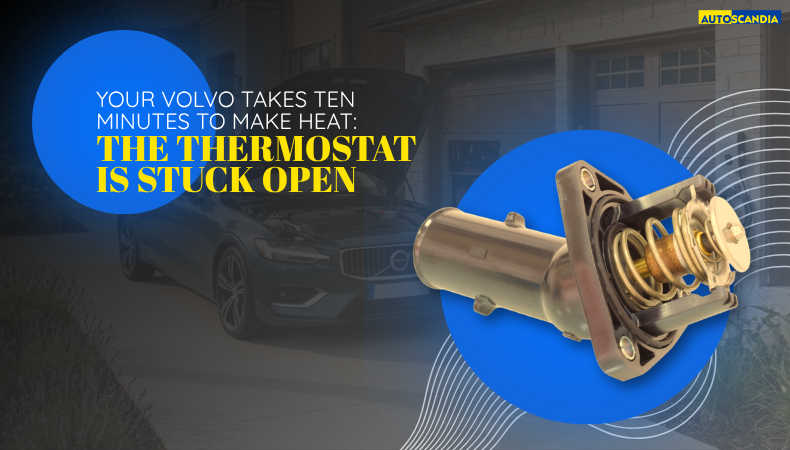
The drive from Herndon down the Fairfax County Parkway is about twelve minutes. If your Volvo is only starting to make warm air as you pull into the lot, something is wrong, and it isn’t the heater.
Stuck open, a thermostat never lets the engine reach operating temperature. Coolant circulates through the radiator the whole time it should be held back, the engine runs cool, and the cabin gets whatever lukewarm air is left over. Auto Scandia has been working on these cars for more than forty years, and this walks in every year once the mornings drop into the forties. Small part. Ignored, it costs you fuel, oil life and a working defroster on the first frosted morning of the year.
Quick Summary: Key Takeaways
- The clue is the gauge, not the vents: a needle that sits below its usual mark once warm points straight at the thermostat.
- P0128 is the code to expect: the computer knows the engine should have been hot minutes ago.
- Fuel economy drops: cold engines run a richer mixture, and you pay for it every mile.
- Defrost gets weak first: less heat means slower clearing of a frosted windshield.
- Late October is the deadline: Dulles normally sees its first freezing night around the 24th.
A Thermostat Stuck Open Holds the Engine Below Its Design Temperature
It’s a valve. Shut until the coolant hits roughly 190 degrees, which is how your engine warms up fast and then holds a steady temperature. Fail it open and the gate never closes, so coolant runs to the radiator from the first mile and throws away heat the engine hasn’t finished using.
Volvo’s five-cylinder and four-cylinder engines both do it. So do the older 850 and S60 platforms our customers still drive. Nothing dramatic happens. The car keeps running, the gauge just settles low, and most owners blame the heater instead of a valve the size of a shot glass.
The Symptoms Look Like Three Unrelated Problems
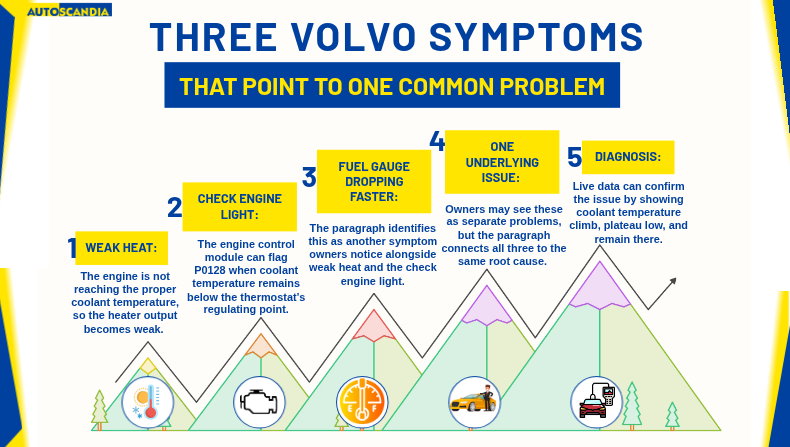
Weak heat. A check engine light. A fuel gauge dropping faster than it used to. Owners usually mention one of the three and never connect it to the other two, which is why the first question at the counter is always about all three symptoms rather than the one that annoyed you enough to call. Same root cause.
Expect P0128, which reads as coolant temperature below the thermostat’s regulating point. The engine control module gives the engine a set window of time to reach temperature, and when the sensor never gets there the module flags it. Live data settles it in five minutes. Watch the coolant temperature climb, plateau low, and stay there.
Running Cool Wears the Engine Out Faster Than Running Warm
Cold engines run rich. The computer holds extra fuel in the mixture until the coolant sensor reports operating temperature, which means an engine sitting at 150 degrees all winter never leaves warm-up enrichment, never hits closed-loop efficiency, and quietly costs you a couple of miles per gallon on every trip down the Parkway.
Some of that fuel slips past the rings and thins the oil. Combustion moisture that would normally boil off stays in the crankcase instead. Neither is a crisis in a week. But a whole winter of it is real wear on a car you were planning to keep, and the part that caused it is one of the cheapest things in the cooling system.
Northern Virginia’s First Freeze Normally Lands in Late October
Herndon sits five miles from the Dulles weather station, so the numbers there are the numbers here. By NOAA’s 1991 to 2020 climate normals, Dulles has a 50 percent chance of its first 32-degree night by October 24, with an average October high of 68 and a low of 45.
That date is your deadline. Circle it. Weak defrost on a 40-degree morning is an annoyance. On the first frosted windshield in Reston, it’s a car you can’t safely pull out of the driveway in, and that’s the version of this problem nobody plans for. Book the repair while it’s still a convenience item.
We Test the Whole Cooling Circuit Before Replacing Anything
Thermostats are cheap, so they get blamed for things they didn’t do. A failed coolant temperature sensor reports a lie to the computer and produces the identical complaint. So does a radiator fan that never shuts off.
So the car gets a proper look. Temperature readings at the housing and both radiator hoses, sensor values checked against an infrared reading, pressure test on the way through. Our technicians are factory-trained and repairs carry a 24-month, 24,000-mile warranty. There’s a free shuttle if you need to get up to Reston Town Center while the car is with us.

Frequently Asked Questions
Q: Why does my Volvo take so long to warm up?
A: The usual answer is a thermostat stuck open, which lets coolant reach the radiator before the engine has come up to temperature. A failed coolant temperature sensor and a radiator fan that never shuts off produce the same symptom.
Q: What does code P0128 mean on a Volvo?
A: It means the coolant stayed below the thermostat’s regulating temperature longer than the engine control module allows. On most Volvos that points at the thermostat first and the coolant temperature sensor second.
Q: Is it safe to drive with a thermostat stuck open?
A: It won’t strand you, but you’ll burn more fuel, dilute your oil and lose defroster performance. In Virginia’s winter that last one is the part worth acting on.
Q: How long does a Volvo thermostat replacement take?
A: On most models it’s a same-visit job, with the coolant drained, refilled and bled properly afterward. The bleed matters more than the part swap, and a rushed refill is how air pockets and false overheating start.
Get It Sorted Before the First Frosted Windshield
If the gauge sits low and the heat is late, say so when you book. That one detail tells us where to start.
Auto Scandia, 134 Spring St, Herndon, VA 20170. Open Monday through Friday, 8:00 AM to 6:00 PM, and Saturday 9:00 AM to 1:00 PM. More at autoscandia.com.