
 Mon – Fri: 8am – 6pm
  134 Spring Street
  (703) 471-4494
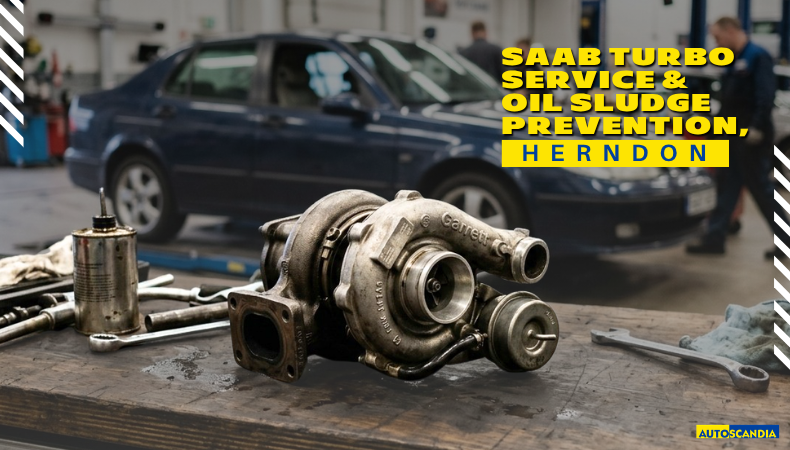
That whistle from under the hood, a puff of blue smoke at startup, oil disappearing between changes: Saab owners in Herndon know the drill. The turbo and the sludge that kills it are the two things a 9-3 or 9-5 needs watched.
Turbocharged engines aren’t niche anymore. They powered roughly a third of new U.S. vehicles in recent model years, per the EPA, and the maintenance rules Saab drivers learned the hard way now apply broadly. Auto Scandia on Spring St has kept these Swedish turbos alive for over 40 years.
Quick Summary: Key Takeaways
- The turbo runs your Saab: it spins past 100,000 rpm on clean oil and dies fast on dirty oil.
- Sludge is the top killer: burnt, thickened oil clogs the turbo feed and starves the bearings.
- Change oil every 5,000 miles: full synthetic and short intervals stop sludge cold.
- Let the turbo cool: idle a minute after hard highway runs before shutdown.
- Early service beats a rebuild: a skipped $100 oil change can become a $4,000 engine.
The Saab turbo is the heart of the car and the first thing to protect
Saab’s turbocharged fours, the B205 and B235 in the 9-3 and 9-5, make their power through the turbo. Protect it, and the car runs strong past 200,000 miles.
The turbo spins past 100,000 rpm and runs glowing hot, so it depends on clean oil for both lubrication and cooling, and the moment that oil gets dirty or thin, the bearings start to fail. A replacement turbo plus labor runs well over $1,500. Regular service is a fraction of that. Cheap insurance, honestly.
Oil sludge is the number-one killer of Saab turbo engines
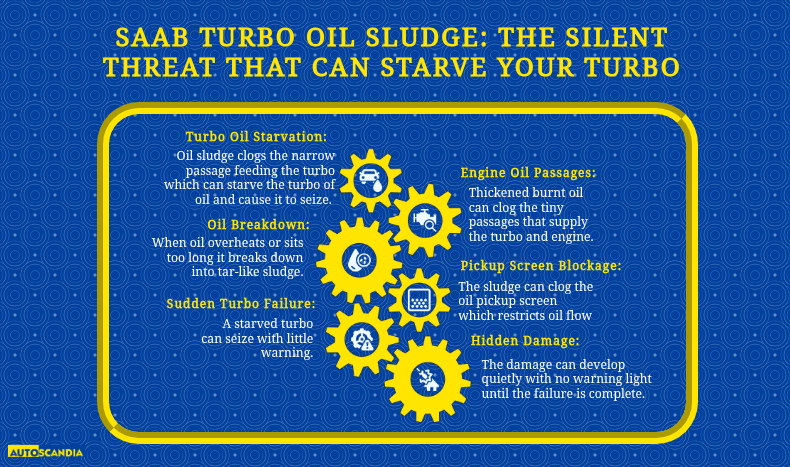
Oil sludge is thickened, burnt oil that clogs the tiny passages feeding the turbo and the engine. It’s the leading cause of Saab turbo death.
When oil overheats or sits too long, it breaks down into a tar-like gunk that clogs the pickup screen and the narrow line feeding the turbo, and a starved turbo seizes with little warning. Saab’s own service bulletins pushed shorter intervals and better oil for this exact reason. Damage comes quietly. No warning light until it’s done.
Short intervals and the right oil stop sludge before it starts
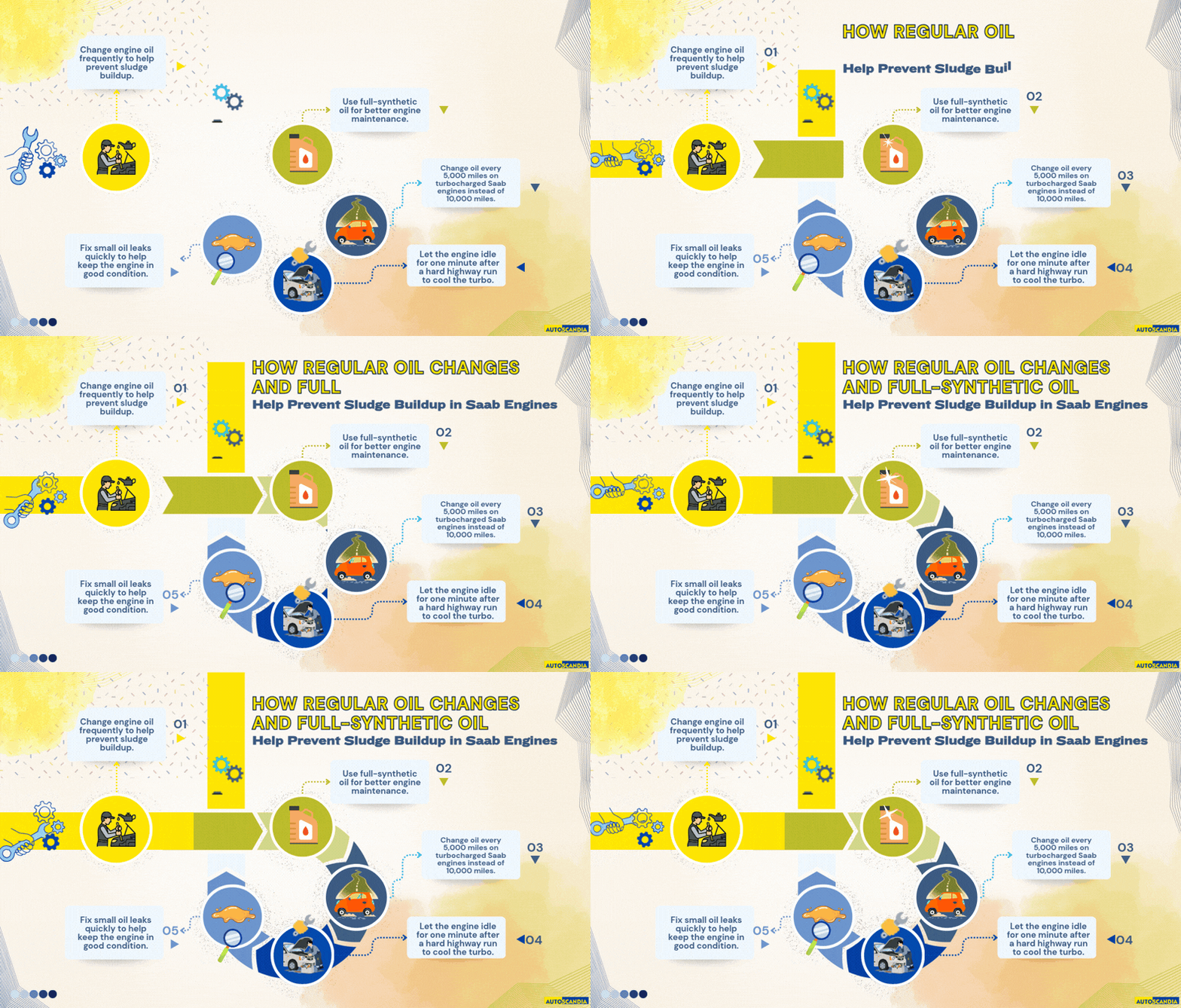
Preventing sludge comes down to two habits: change the oil often, and use full synthetic. Skip either and sludge wins.
We recommend full-synthetic oil changes every 5,000 miles on a turbocharged Saab, not the 10,000-mile intervals some general shops quote, because that extra margin is exactly what keeps sludge from ever getting a foothold. Let the engine idle a minute after a hard highway run so the turbo cools before shutdown. Fix small oil leaks fast. Routine keeps these cars alive.
Ignoring turbo maintenance turns a cheap fix into a rebuild
Put off Saab turbo service, and the bill grows fast. A $100 oil change skipped becomes a $1,500 turbo or a $4,000 engine.
Once sludge starves the turbo and it fails, metal debris circulates through the engine and scores the bearings, so you’re no longer replacing a turbo; you’re looking at a rebuild or an engine swap. With Saab out of business, parts take patience and sourcing skill. Catching it early keeps a rare car on the road. Waiting doesn’t.
Auto Scandia services Saab turbos with dealer-level tools
We service the entire turbo system, oil included. That means inspecting the feed and return lines, the wastegate, boost pressure, and the oil screen.
Our factory-trained techs check for turbo shaft play, oil leaks, and early sludge on every Saab, then flush the system and refill with the correct synthetic so the turbo keeps getting clean oil. Dealership-level scan tools read boost and fault codes the parts-store readers miss. Forty-plus years on European cars. We know these engines.
Herndon’s Saab drivers have trusted Auto Scandia since 1978
Auto Scandia has serviced Scandinavian and European cars in Herndon since 1978. We’re one of the few shops still keeping Saabs on the road.
Find us on Spring St, just off Route 28 and the Fairfax County Parkway near Reston Town Center, where ASE-certified techs back every repair with a 2-year, 24,000-mile warranty. Saab, Volvo, BMW, and more. Free shuttle, discounted rentals, and honest advice. We’re still here when your Saab needs someone who knows it.
Frequently Asked Questions
Q: How often should I change the oil in a turbo Saab?
A: Every 5,000 miles with full-synthetic oil on a turbocharged 9-3 or 9-5. Longer intervals invite sludge, which is the top killer of these engines. Consistent short intervals are the cheapest protection you can buy.
Q: What are the signs of oil sludge in a Saab engine?
A: Oil disappearing between changes, low oil pressure, a rattling turbo at startup, blue smoke, and gunk under the oil cap. By the time symptoms show, damage is often underway. Regular inspection catches it earlier.
Q: Can you still get parts for an older Saab?
A: Yes. Saab stopped building cars, but turbo, engine, and service parts are still available through specialist suppliers. Sourcing takes experience, which is where a longtime Saab shop earns its keep.
Q: Is it worth fixing an old Saab turbo?
A: Often, yes. A well-maintained 9-3 or 9-5 easily runs past 200,000 miles, and a turbo service costs far less than a comparable newer car. Neglected sludge damage is the deciding factor, and we’ll assess it honestly.
Book Saab turbo service at Auto Scandia in Herndon
Hearing a whistle or burning oil in your Saab? Get the turbo and oil system checked before sludge takes the engine. Schedule service with Auto Scandia and keep your Saab running.
Auto Scandia — 134 Spring St, Herndon, VA 20170
Hours: Mon–Fri 8:00 AM – 6:00 PM; Sat 9:00 AM – 1:00 PM; Sun closed
Website: autoscandia.com