
 Mon – Fri: 8am – 6pm
  134 Spring Street
  (703) 471-4494

You climb into your BMW or Volvo after work, and there’s a faint sweet, syrupy smell — like warm maple syrup — that wasn’t there last month. Don’t ignore it. On a European car, that smell is almost always leaking coolant, and it’s the first warning you’ll get before the temperature gauge starts its climb toward the red.
Summer makes it urgent. Sitting in stop-and-go traffic on I-66 or the Fairfax County Parkway on a 95-degree afternoon is exactly when a small coolant leak turns into a full overheat on the shoulder. Catch the smell now, and the fix is cheap. Here’s what it means, and what to do about it around Herndon.
Quick Summary: Key Takeaways
- Sweet smell means coolant: That syrupy odor is leaking antifreeze, usually before you’ll see a puddle.
- European cars leak at known spots: Plastic thermostat housings, expansion tanks, and hoses crack with heat and age.
- Summer traffic is the test: Idling in I-66 heat is when a small leak becomes an overheat.
- Watch for the trio: Sweet smell, low coolant, and a creeping temp gauge all point the same way.
- Don’t top off and ignore it: Refilling hides the leak; the part still needs fixing before it strands you.
What That Sweet Smell Is Actually Telling You
The odor is leaking coolant. Your nose usually catches it before your eyes ever do. Antifreeze is made with ethylene glycol, which smells distinctly sweet when it warms up, so the moment coolant drips onto a hot engine and burns off, you get that syrupy smell wafting through the vents or rolling out when you pop the hood. It’s one of the most reliable early warnings a car gives you.
Where it’s coming from tells the story. A smell with no puddle usually means coolant is hitting a hot surface and evaporating — a seeping hose, or a hairline crack in a plastic housing. A sweet smell inside the cabin, with the windows fogging up, points somewhere else entirely: a leaking heater core, which is a different and more involved repair.
Why European Cars Spring Coolant Leaks in Summer Heat
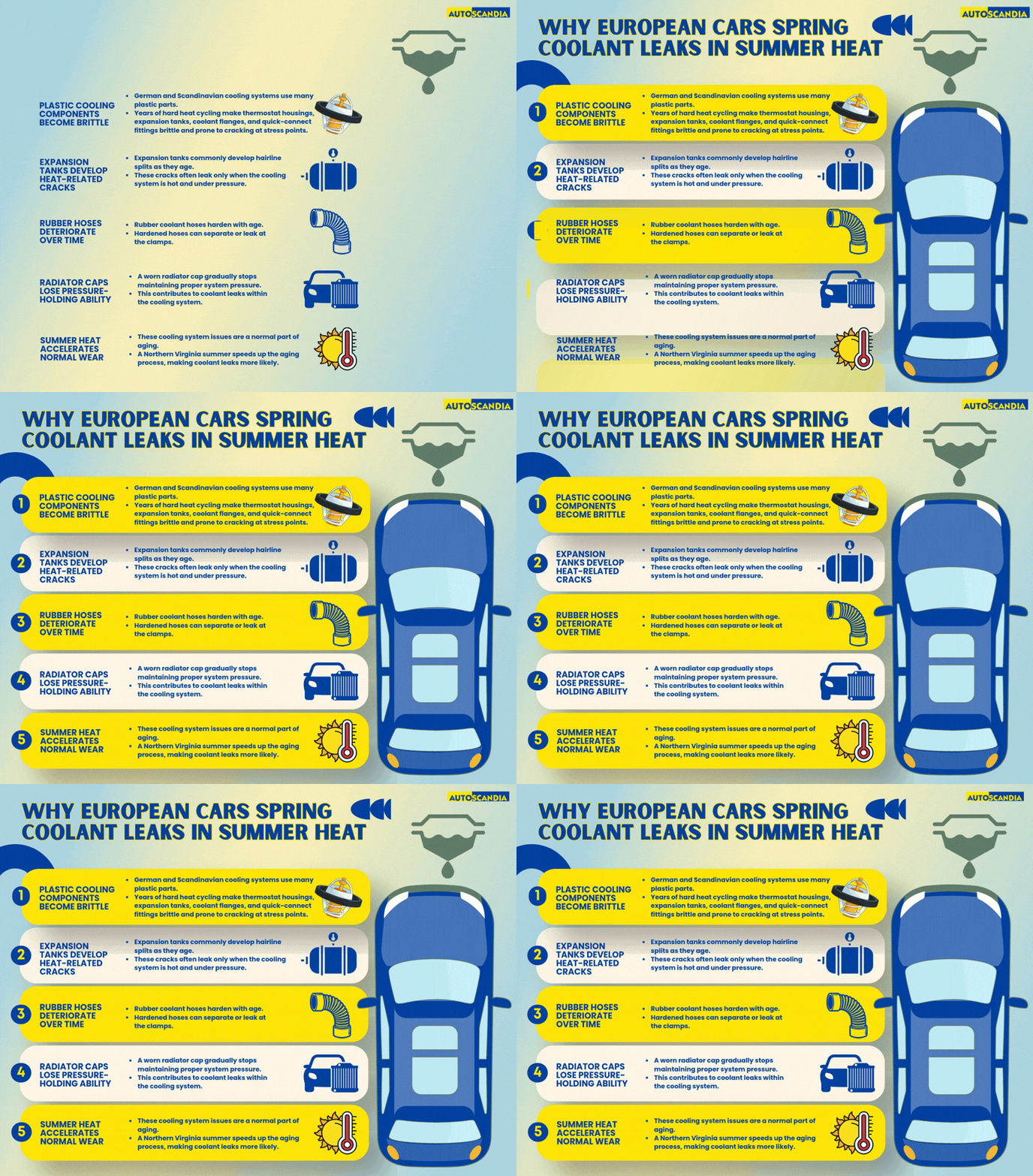
German and Scandinavian cooling systems use a lot of plastic, and heat is what finally finishes it off. Thermostat housings, expansion tanks, coolant flanges, and the quick-connect fittings on BMW, Mercedes, Audi, and Volvo engines are often molded plastic, and after years of hard heat cycling they grow brittle and crack right at the stress points. The expansion tank is the classic. It develops a hairline split that only seeps when the system is hot and pressurized.
Rubber hoses harden and let go at the clamps, and a tired radiator cap quietly stops holding pressure. None of it is unusual. It’s just the ordinary way these systems age, and a Northern Virginia summer only speeds the clock.
Why I-66 Summer Traffic Turns a Small Leak Into an Overheat
Cooling systems fail under load, and nothing loads yours like idling in traffic on a hot day. Crawling east on I-66 toward the Beltway, or stuck dead near the Route 28 interchange, there’s no airflow through the radiator except what the fan can drag, and the AC compressor is dumping still more heat into the mix the whole time. A system already down a little coolant simply can’t keep up. The gauge climbs.
This is peak breakdown season for a reason. AAA expected to rescue 7.7 million drivers over the summer of 2025, and overheating is one of the top reasons a commute ends on the shoulder. A leak you smell in May is a whole lot cheaper than a tow in July.
Why Topping Off the Coolant Doesn’t Fix It
Adding coolant treats the symptom. It hides the problem. And that’s precisely how small leaks grow into big repairs. If you’re refilling the reservoir every couple of weeks, the coolant is going somewhere, and the leak is still right there — you’ve only delayed the day it strands you. Worse, running low lets air into the system and lets the temperature spike without much warning.
There’s a real cost to waiting. A cracked expansion tank or a leaking hose is often a couple hundred dollars fixed. Let it overheat on I-66 and cook the head gasket, though, and you’re suddenly into the thousands. Don’t gamble the whole engine just to skip a diagnosis.
How We Find and Fix a Coolant Leak
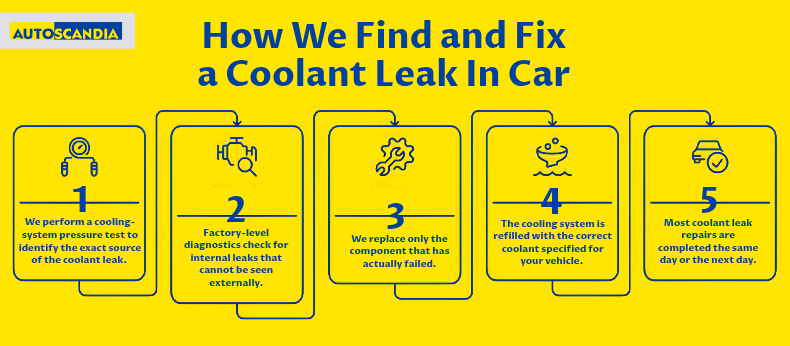
We start with a cooling-system pressure test, not a guess. Pressurizing the system while it’s cool shows us exactly where coolant escapes — the tank, a hose, the water pump, or a housing — and factory-level diagnostics confirm whether anything is leaking internally past a gasket where you’d never spot it. From there we replace what actually failed and refill with the correct coolant for your make, never a universal jug.
We’ve serviced European cars in Herndon for more than 40 years, from our shop on Spring St near the town center. Most coolant repairs go out the same day or next. They’re backed by our 24-month/24,000-mile warranty, and you get a straight answer on what needed fixing and what didn’t.
Frequently Asked Questions
Q: Why does my car smell sweet like syrup?
A: That sweet, syrupy smell is almost always leaking engine coolant. Antifreeze contains ethylene glycol, which smells sweet when it’s warm, so a small leak dripping onto a hot engine gives off the odor through the vents or under the hood — often well before you’ll see a puddle. Have the cooling system pressure-tested to find the source.
Q: Is it safe to drive a car that’s leaking coolant?
A: Only briefly, and never in summer traffic. A car low on coolant can overheat fast when it’s idling in heat, and driving it hot risks warping the head or blowing the head gasket. If you smell coolant or the temperature gauge starts to climb, get it checked before your next drive on I-66.
Q: Can I just keep adding coolant instead of repairing the leak?
A: No. Topping off hides the leak but doesn’t fix it, and running low lets air into the system and temperatures spike. If you’re refilling every couple of weeks, the leaking part still needs to be repaired before it leaves you stranded somewhere inconvenient.
Q: How much does a coolant leak repair cost on a European car?
A: It varies by the part. A leaking hose, expansion tank, or thermostat housing is often a few hundred dollars. A water pump or radiator costs more, and a leaking heater core is more involved still. If overheating has already damaged the head gasket, repairs run into the thousands, which is why catching the leak early saves real money.
Smell Coolant? Get It Checked Before Your Next Commute
Catching that sweet smell in your European car? Bring it to our Herndon shop for a pressure test before summer traffic turns it into a tow.
Auto Scandia — 134 Spring St, Herndon, VA 20170
Hours: Monday–Friday, 8:00 AM – 6:00 PM; Saturday, 9:00 AM – 1:00 PM; Sunday closed
Website: autoscandia.com