
 Mon – Fri: 8am – 6pm
  134 Spring Street
  (703) 471-4494
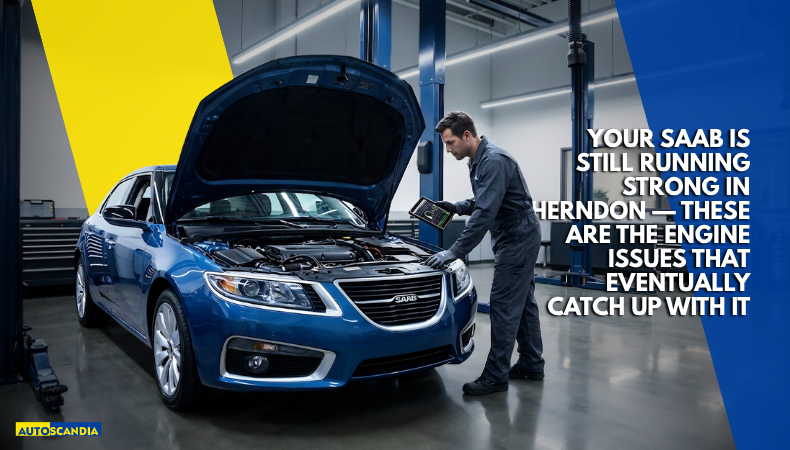
There’s a reason Saab owners in Herndon tend to hold onto their cars. The brand built a devoted following with its turbocharged performance, safety engineering, and driving feel that nothing off an assembly line today quite replicates. But most of the Saabs still on the road are aging vehicles, and the engines that power them — particularly the B207 and its variants — have well-documented failure patterns that every Northern Virginia Saab owner should understand. Whether you’re commuting on the Dulles Toll Road or running errands around Reston Town Center, catching these problems early is the difference between a straightforward repair and a much more expensive one. Auto Scandia on Spring Street has been Herndon’s Saab specialist for over 40 years — here’s what they see most often.
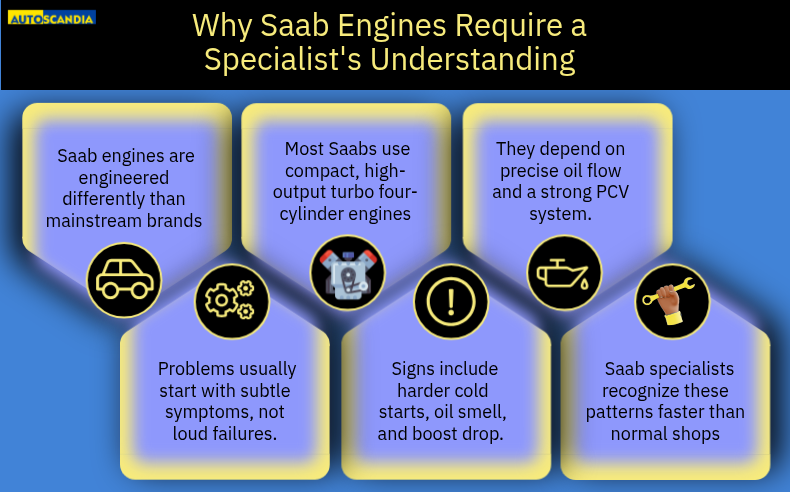
Why Saab Engines Require a Specialist’s Understanding
Saab’s engineering philosophy was always a little different from the mainstream. The turbocharged four-cylinder engines that power most modern Saabs are compact, high-output units that depend on precise oil flow, clean intake passages, and a well-functioning PCV system to operate at their best. When any one element falls out of spec — and they do — the failure rarely announces itself loudly. Instead, you get subtle signs: slightly harder cold starts, a faint oil smell after a warm-up, or a drop in boost that’s easy to attribute to normal aging. Technicians who work on Saabs regularly know what these signs mean because they’ve seen the pattern before. Shops that don’t specialize in the brand often miss them until the symptoms become unmistakable. Visit the Saab repair page at Auto Scandia to see the full scope of services available for your vehicle.
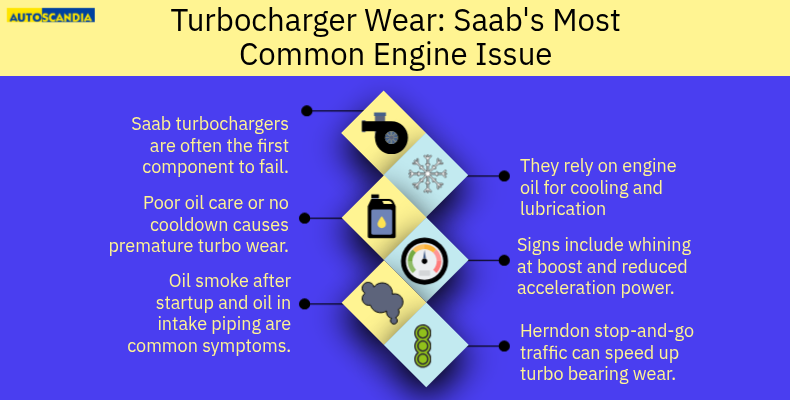
Turbocharger Wear: Saab’s Most Common Engine Issue
The turbocharger is central to the Saab driving experience and one of the first components to develop problems. Saab turbos depend heavily on engine oil for lubrication and cooling, which means any lapse in oil changes, any oil quality degradation, or any delay in allowing the engine to cool down after hard driving creates conditions for premature turbo wear. Symptoms include a whistling or whining noise at boost, reduced power during acceleration, visible oil smoke from the exhaust after startup, or oil found in the intake piping. In Herndon’s stop-and-go traffic — especially on Routes 7 and 28 — turbochargers that never get the sustained high-RPM flush they need can develop bearing wear faster than the service interval suggests.
Timing Chain Stretch on the B207 Engine
The B207 engine, used in the 9-3 and 9-5 from the mid-2000s onward, has a well-known vulnerability with timing chain stretch. The timing chain keeps the camshafts and crankshaft synchronized, and when it stretches, timing drifts out of spec. Early symptoms include a rattling noise on cold startup that fades as oil pressure builds, rough idle, and in some cases a check engine light for camshaft position errors. Left unaddressed, a stretched timing chain can jump a tooth or break entirely — at that point, you’re looking at potential valve damage and a substantially more expensive repair. The diagnosis requires a specialist familiar with Saab-specific timing system behavior, because the early warning signs are subtle enough to be missed on a generic scan.
PCV System Failure and What It Does to the Engine
The positive crankcase ventilation (PCV) system on Saab’s turbocharged engines is prone to failure, and when it goes, the consequences are significant. A failing PCV system allows crankcase pressure to build up and forces oily vapors back into the intake manifold. This produces oil consumption without a visible external leak, deposits on the intake valves, and — in more advanced cases — rough running and misfires. If you’re adding oil between changes without seeing any drips in your parking spot, the PCV system is one of the first things a Saab-experienced technician will investigate. Auto Scandia’s team handles engine repair in Herndon with factory-grade diagnostic equipment that can identify PCV failure and related intake contamination before it compounds.
Why Early Diagnosis Always Wins
Every Saab engine issue described here has a straightforward resolution when caught early. A turbo bearing showing early wear can be addressed before the turbo fails completely. A timing chain starting to stretch can be replaced before it causes valve damage. A PCV system leaking oil vapor can be cleaned and corrected before the intake valves require carbon cleaning. The common thread is that none of these problems are emergencies at the early stage — but they become expensive ones if ignored. Auto Scandia’s 24-month/24,000-mile warranty covers the repairs properly, and the shop’s shuttle service means a Saab visit on a weekday doesn’t have to derail your schedule. Schedule a service appointment online or call to get in front of these issues before they escalate.
FAQ
What are the most common Saab engine problems?
The most frequently seen Saab engine issues include turbocharger wear from oil starvation or heat, timing chain stretch on the B207 engine, PCV system failure causing oil consumption and intake contamination, and carbon buildup on direct injection variants. All of these develop gradually and are easiest to address when caught early by a specialist.
How do I know if my Saab’s turbo is failing?
Common signs of Saab turbo failure include a whistling or whining noise under boost, reduced acceleration, oil smoke from the exhaust on startup, and oil in the intercooler piping. A technician familiar with Saab turbocharged engines can confirm turbo condition with a boost pressure test and visual inspection.
Can Saab engine problems be prevented with regular maintenance?
Yes. Consistent oil changes with the correct grade, timely cooldown periods after spirited driving, and regular inspections of the PCV and timing systems go a long way toward preventing the most common Saab engine failures. A specialist who knows the platform will know exactly what to check and when.
Does Auto Scandia in Herndon service Saab vehicles?
Yes. Auto Scandia has been specializing in Saab repair in Herndon for over 40 years, with factory-trained technicians, dealer-level diagnostic equipment, and a 24-month/24,000-mile warranty on all work performed.
Keep Your Saab Running the Way It Was Built To
Auto Scandia has been Herndon’s trusted European and import specialist since 1985, with decades of Saab-specific experience and every tool needed to diagnose and repair whatever your vehicle needs.
📍 134 Spring Street, Herndon, VA 20170 📞 (703) 471-4494 🕐 Mon–Fri: 8:00 AM–6:00 PM | Sat: 9:00 AM–1:00 PM 🌐 autoscandia.com